 Add to Chrome
 Add to Firefox
 Add to Edge
reversible data hiding in encrypted image
Papers and Code
CausalVE: Face Video Privacy Encryption via Causal Video Prediction
Sep 28, 2024
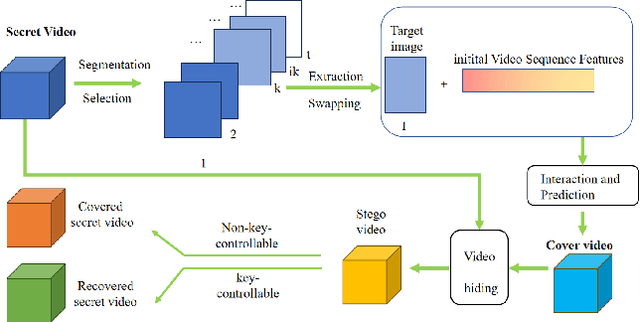
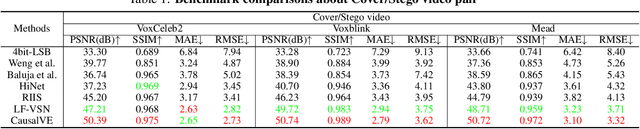
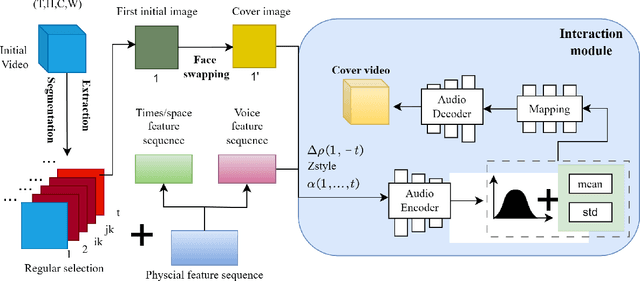

Advanced facial recognition technologies and recommender systems with inadequate privacy technologies and policies for facial interactions increase concerns about bioprivacy violations. With the proliferation of video and live-streaming websites, public-face video distribution and interactions pose greater privacy risks. Existing techniques typically address the risk of sensitive biometric information leakage through various privacy enhancement methods but pose a higher security risk by corrupting the information to be conveyed by the interaction data, or by leaving certain biometric features intact that allow an attacker to infer sensitive biometric information from them. To address these shortcomings, in this paper, we propose a neural network framework, CausalVE. We obtain cover images by adopting a diffusion model to achieve face swapping with face guidance and use the speech sequence features and spatiotemporal sequence features of the secret video for dynamic video inference and prediction to obtain a cover video with the same number of frames as the secret video. In addition, we hide the secret video by using reversible neural networks for video hiding so that the video can also disseminate secret data. Numerous experiments prove that our CausalVE has good security in public video dissemination and outperforms state-of-the-art methods from a qualitative, quantitative, and visual point of view.

A general framework for reversible data hiding in encrypted images by reserving room before encryption
Apr 15, 2021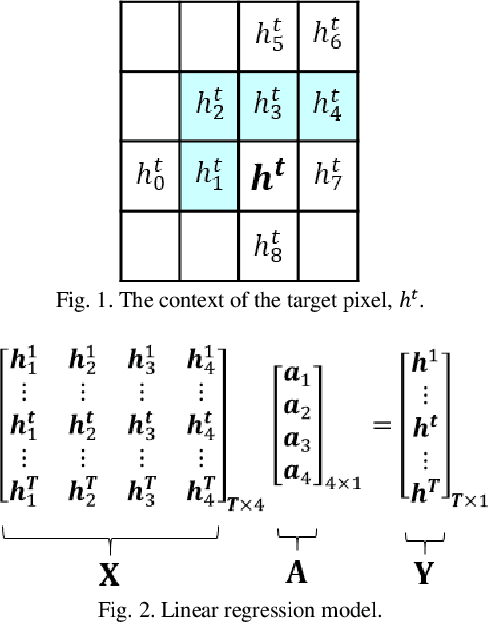
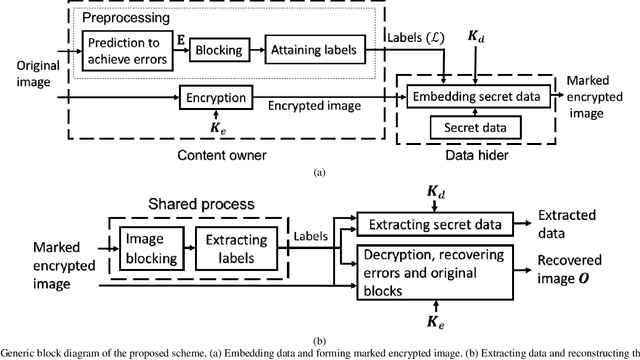


In this paper a general framework to adopt different predictors for reversible data hiding in the encrypted image is presented. We propose innovative predictors that contribute more significantly than conventional ones results in accomplishing more payload. Reserving room before encryption (RRBE) is designated in the proposed scheme making possible to attain high embedding capacity. In RRBE procedure, pre-processing is allowed before image encryption. In our scheme, pre-processing comprises of three main steps: computing prediction-errors, blocking and labeling of the errors. By blocking, we obviate the need for lossless compression to when content-owner is not enthusiastic. Lossless compression is employed in recent state of the art schemes to improve payload. We surpass prior arts exploiting proper predictors, more efficient labeling procedure and blocking of the prediction-errors.